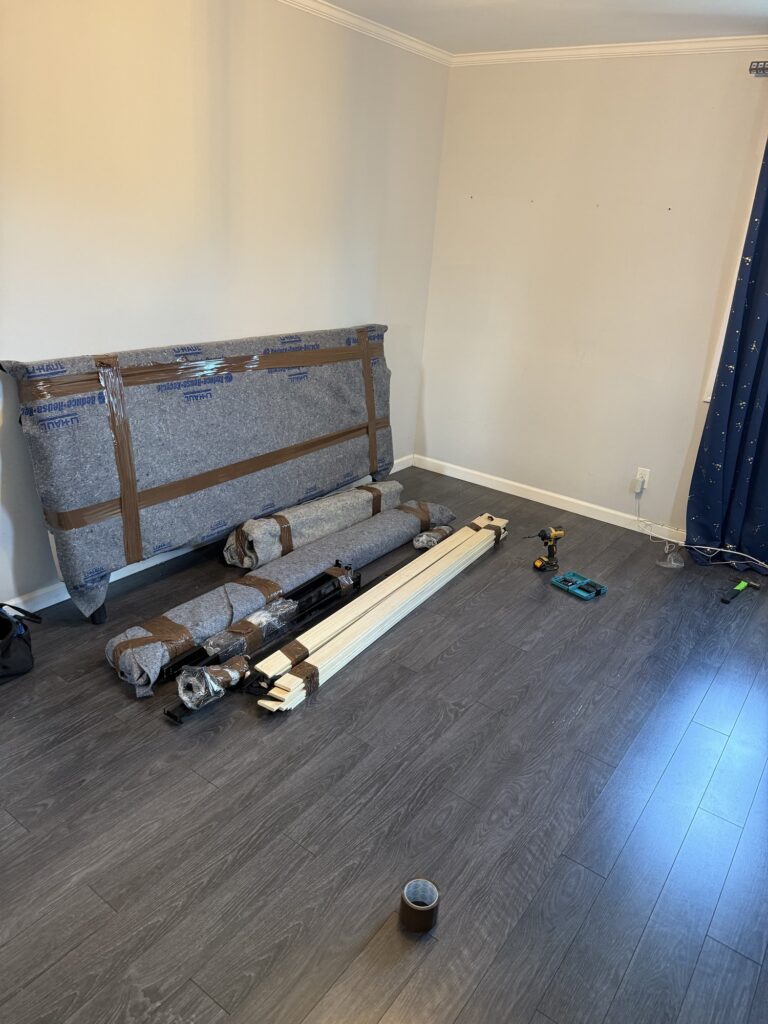
Pad each piece with moving blankets, then wrap stretch film over the blankets so the padding stays put. Glass, mirrors and fragile finishes need a few extra steps, covered piece by piece below.
Key takeaways
- Moving blankets go on first as padding, and stretch film wraps over them to hold everything in place.
- Tape on a finished surface can pull off lacquer, so tape only ever fastens padding to padding.
- Glass shelves and doors are usually taken out of china cabinets and curios and wrapped separately.
- Mirrors and glass table tops are usually carried on edge rather than flat.
- Wrapping is part of the job and billed at the same hourly rate as the rest of the move, for the time actually worked. The exact price comes from photos or a video.
Why every piece gets wrapped, not just the fragile ones
Should furniture be wrapped when moving? Yes, and that includes the sturdy pieces. Very little wear happens on an open floor. Most of it happens in a handful of predictable spots:
- Door frames, where a piece is tilted and squeezed through.
- Banisters and stair turns, where corners swing close to walls and railings.
- Truck walls, where pieces lean during the drive.
- The piece next to it, because furniture rides side by side in the truck.
Moving heavy furniture means tipping it, pivoting it and setting it down again and again between the rooms and the truck. A moving blanket takes the rub and the bump at each of those points. Stretch film keeps the blanket from slipping off halfway down the stairs, and it keeps dust off the padding too. That pairing works the same whether the residential moving job is a city apartment or a full house.
Blankets, stretch film, bubble wrap: what each material does
What is the best way to wrap furniture for moving? Padding first, film second. Moving blankets are the padding layer and stretch film is the outer layer. These two packing supplies do different jobs, so one can’t stand in for the other.
Cling film, cling wrap and stretch film are different names for the same thing: a self-sticking furniture plastic wrap that grips itself and holds without tape. Bubble wrap is cushioning. It’s handy on corners, legs and small fragile items. On a large piece it doesn’t replace a blanket, since it’s thin and tears the first time it catches a door frame.
A common mistake is putting plastic straight onto bare wood or leather. The film can rub the surface and trap moisture against it, which is why the blanket goes underneath. If you’d like the boxes and small items handled as well, see our packing services.
| Material | What it does | Where it fits | Where it’s the wrong choice |
|---|---|---|---|
| Moving blankets | Pads the piece and takes bumps and rubbing | Wood, frames, corners, glass removed from cabinets | As the only layer on a long carry, because it can slide off |
| Stretch film | Holds padding in place, keeps dust off, holds drawers and doors shut | Over blankets; over upholstered fabric | Straight on bare wood, lacquer or leather |
| Bubble wrap | Cushions small areas | Corners, legs, small fragile items | As a substitute for a blanket on a large piece |
| Tape | Fastens padding to padding | On blankets or film only | On any finished surface |
Dressers and wood pieces: no tape on the finish
To wrap a dresser for a move, cover the wood with moving blankets and wind stretch film over them. Tape shouldn’t go on finished wood at all. It can pull off lacquer, and the sticky residue it leaves behind is a pain to clean.
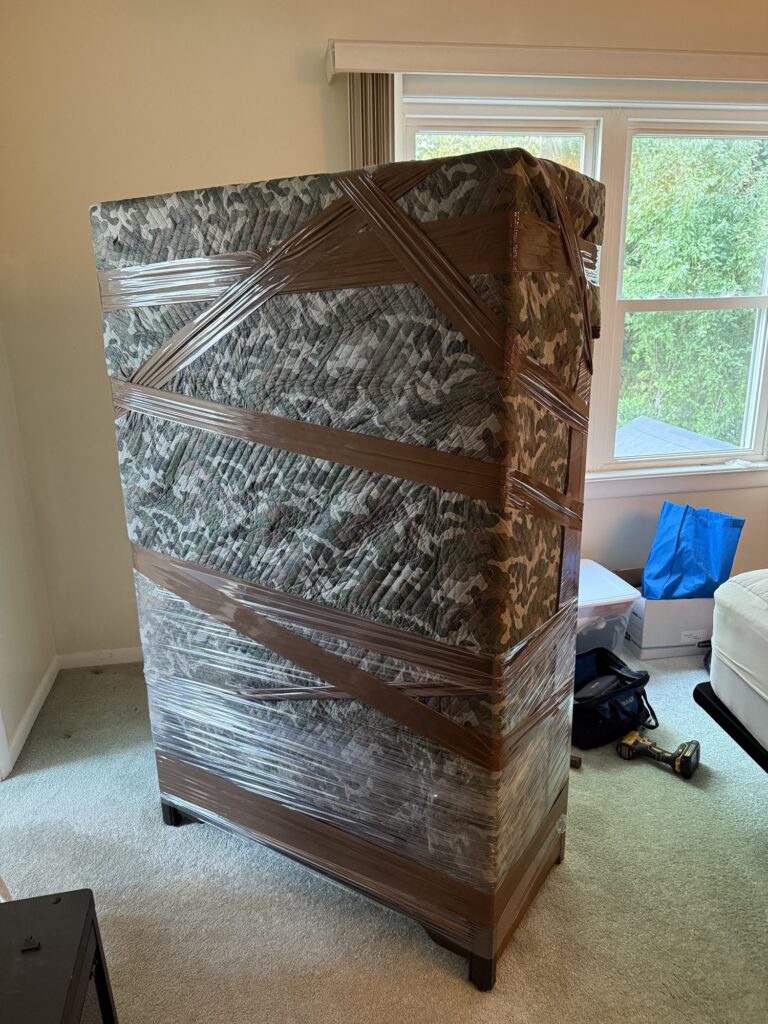
Here’s one of ours: a tall dresser padded in moving blankets, with stretch film wound over the padding. On a piece like this, the film does double duty. It keeps the blankets from creeping when the dresser is tilted, and it holds the drawers shut so they can’t slide open on the way down the stairs or in the truck. Because the film wraps the blanket rather than the wood, the finish stays covered the whole time.
Empty drawers make a dresser lighter to carry and put less strain on the frame when it’s tipped. If a dresser has an attached mirror, or a piece is too big for the doorway, it may need to come apart first. Our guide on whether movers disassemble furniture explains how that works.
Sofas and couches: what we wrap them in
What can I wrap my couch in when moving? Plastic film suits the upholstery, and moving blankets suit the hard parts. The film keeps the fabric clean on stairs and in the truck. The blankets cover the wooden legs, arms and frame corners, which are the parts that actually hit things.
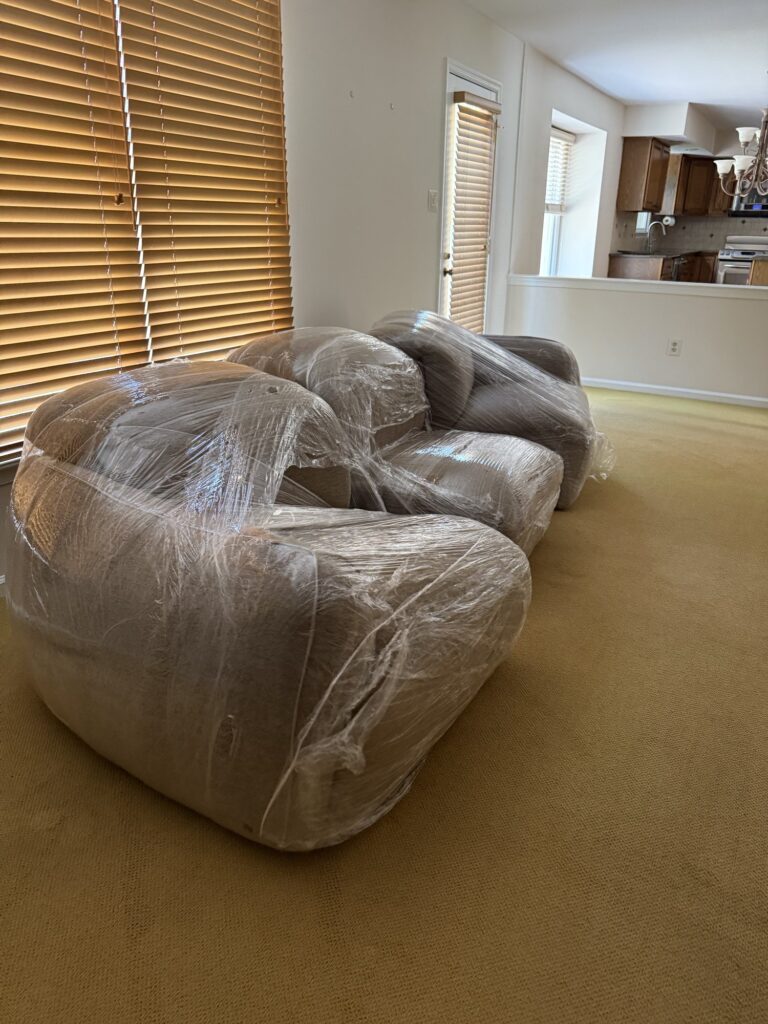
A sofa of ours, sealed in plastic film, waits in the living room for moving day. Once the couch plastic wrap is on, the upholstery is covered against dust and grime, both on the walk out to the truck and on the truck floor itself. That’s the main job of plastic on a couch: keeping the fabric clean from the old home to the new one.
Exposed wood is a different story. Legs, the outer corners of the frame and wooden arm caps are where a sofa meets door frames and the truck wall. Padding those spots with a blanket first and then running the film over it protects the fabric and the frame at once.
One mistake to avoid: leaving a sofa sealed in plastic for a long stretch, especially in heat. Moisture can get trapped against the fabric. Film is meant for the move, not for weeks of sitting.
China cabinets: glass shelves and doors come out first
A china cabinet gets wrapped in stages. The glass shelves and glass doors are usually removed and wrapped separately. Then the empty body is padded with moving blankets and wrapped in stretch film. The reason is simple: glass left loose inside a cabinet shifts every time it’s tilted, and it can break itself and damage the frame around it.
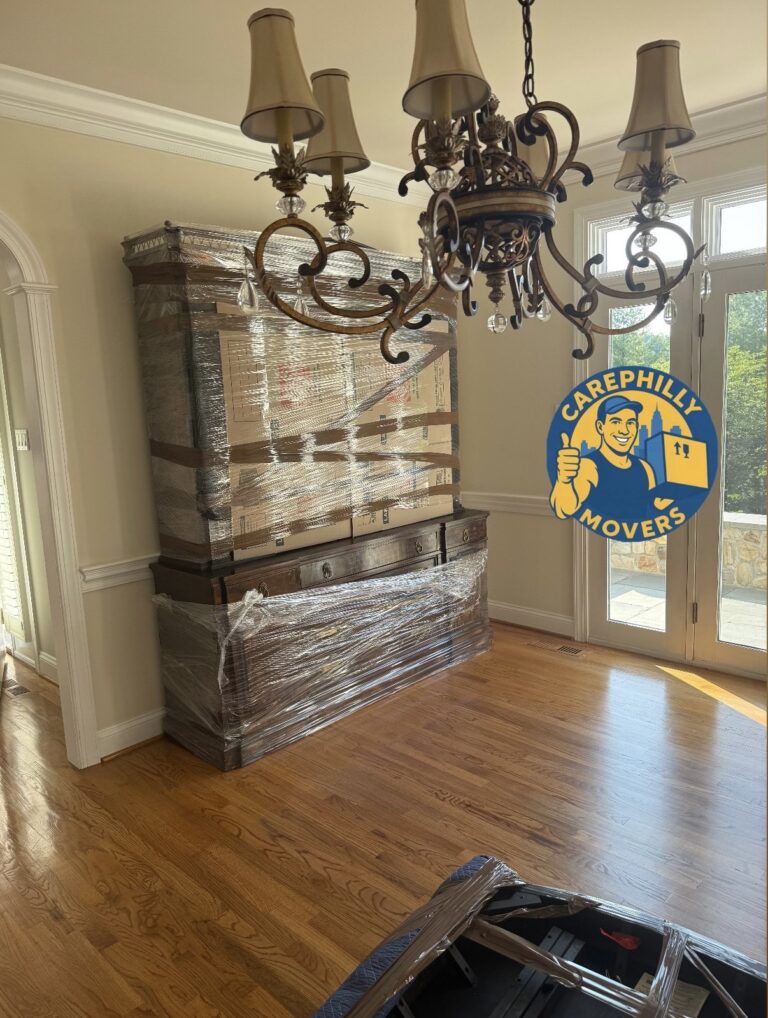
Here, a china cabinet in the dining room is wrapped in moving blankets and stretch film.
The dishes get packed before the cabinet is wrapped. They don’t ride on the shelves. You can box them yourself, or have our team handle it through our packing services in Philadelphia. For pieces that need extra care, see our white glove moving service.
Glass curio cabinets: padding all around
A glass curio cabinet is mostly glass, so it needs padding on every side. As with a china cabinet, the glass shelves and doors are usually taken out and wrapped on their own before the frame is covered.
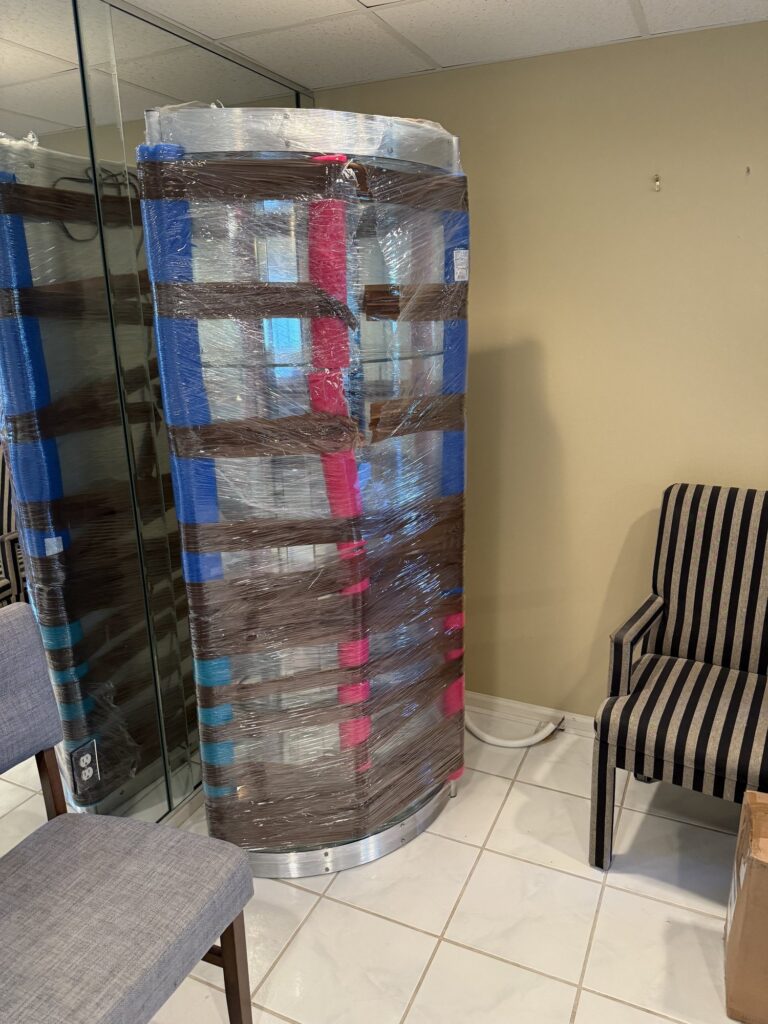
This curio of ours is wrapped with padding and tape. When tape shows up on a wrapped piece, it belongs on the padding, fastening padding to padding. It doesn’t go on the finish.
The frame itself gets padding all the way around, not just on the front. A curio has a lot of glass and thin edges, and any side can brush a wall on the way out. If the curio holds a collection you care about, ask about white glove moving when you request a quote.
Mirrors and glass table tops ride upright
Mirrors and glass table tops are usually carried and stood on edge rather than laid flat. Glass lying flat flexes, and it can crack under its own weight or under whatever ends up stacked on top. Standing on edge, it carries the load along its strong side.
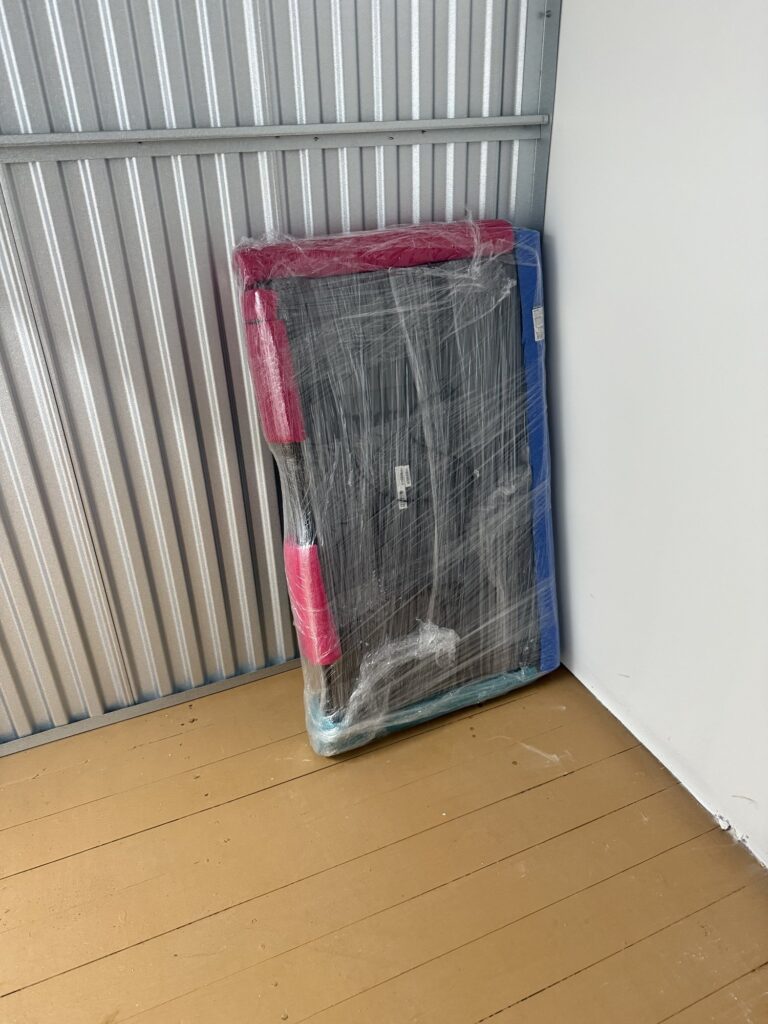
Stretch film keeps a mirror’s surface clean and makes it easier to grip and handle.
Glass table tops come off the base and are wrapped separately. The top and the base then travel as two pieces, so the glass isn’t resting on legs or brackets that could press into it during the drive.
Some large or valuable glass pieces need more than soft wrapping. For those, crating is a separate service we offer: the piece goes into a rigid box built around it. Not sure whether a piece needs it? Ask when you request a quote, or look at our white glove moving service.
Wrapped furniture in Philadelphia rowhouses and trinity stairs
In Philadelphia, wrapping earns its keep on tight stairs and turns. Rowhouses are the most common type of home in the city. Trinity houses stack three or four floors of about one room each, joined by small winding stairways, and that layout makes moving furniture between floors hard. On turns that tight, the wrap is what keeps a piece from rubbing the walls and the railing as it pivots.
There, padding protects both the piece and the building.
When the truck stands on a city street in Philadelphia, it needs a Temporary No Parking permit from the city. The city charges $25 per 40 feet of curb per day, or $50 in Center City and University City, and the permit has to be requested at least four business days before the move. Forty feet is about two parking spaces.
Unwrapping and setting up at the new home
At the new home, the wrapping comes off and each piece goes where you want it.
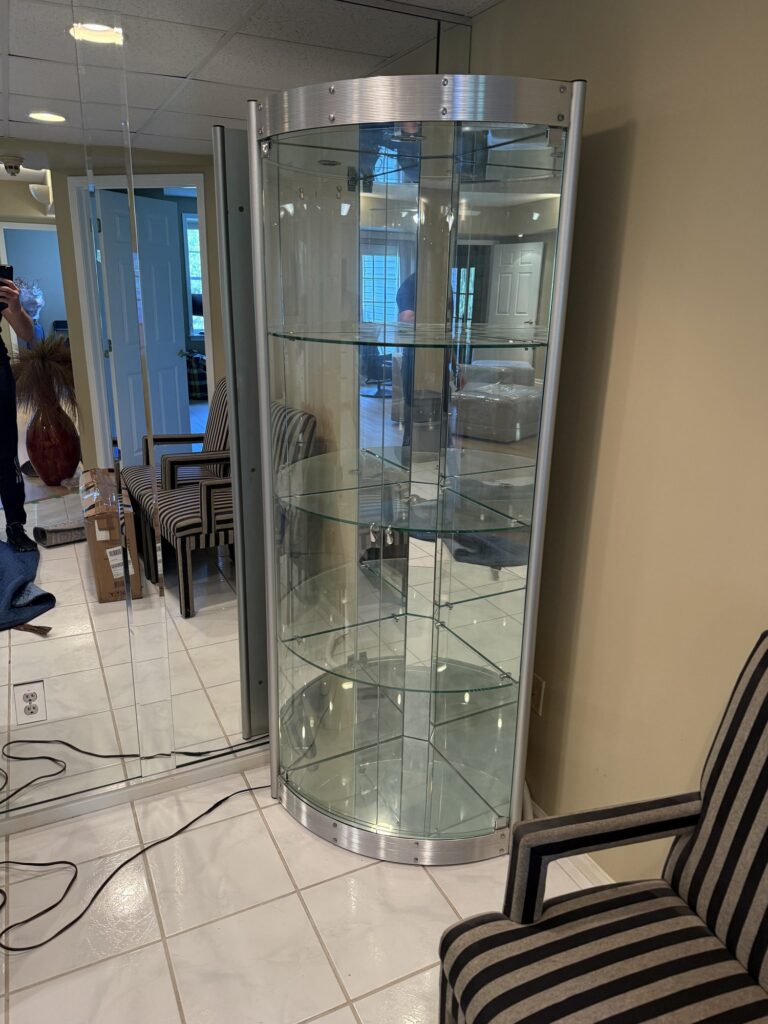
Here’s the glass curio cabinet from earlier, out of its wrap and set up after the move. That’s the point of all the padding and film: the piece arrives, the wrapping comes off, and you get it back in place, assembled and ready for its contents. Any glass that was taken out for the trip goes back into its frame once the piece is standing in its new spot.
If you have other items that need putting together, such as beds or tables, our furniture assembly service covers that work.
How wrapping fits into the time and the bill
Wrapping and padding are billed at the same hourly rate as the rest of the move, for the time actually worked: $150/hour for 2 movers with the truck, $200/hour for 3 movers and $250/hour for 4 movers, with a 3-hour minimum. We don’t give a flat price for local moves. The moving estimate is non-binding, and the bill follows the hours.
Rough time: a studio takes 3–4 hours, a one-bedroom 4–6, a two-bedroom 6–8, a house 8–12 or more, and that is very approximate.
Time depends on how much stuff there is, how many stairs and floors the crew climbs, whether there’s an elevator, how far the truck can park, which furniture has to come apart and the distance between addresses. A china cabinet with removable glass takes longer to wrap than a bookshelf does, and furniture disassembly adds its own time on top.
The price depends on the volume of work, and we give the exact one from photos or on site. For how hourly pricing works, read how much movers cost. Moving just a few pieces? Look at our small moves service.
What to do before the crew arrives
A little prep lets the wrapping start as soon as the crew walks in. A short checklist:
- Dishes are out of the china cabinet and packed, by you or by our packing service.
- Pieces with glass and fragile finishes are pointed out to the crew.
- Cash, jewelry, documents and medications are set aside to travel with you, not on our truck.
- Photos or a video of the furniture are sent with your quote request.
Emptying drawers and cabinets helps too, since lighter pieces are easier to carry and tilt. Propane tanks, flammable liquids and other hazardous materials don’t go on the truck.
Some things you can wrap yourself. A simple bookshelf or a plastic chair doesn’t need special handling. Glass and antique finishes are better left to the crew. For the rest of the prep, our apartment moving checklist walks through it step by step.
Get a quote from photos of your furniture
Show the glass pieces especially: china cabinets, curios, mirrors and glass tops. Your moving estimate is based on what we see.
We move within Pennsylvania only: Philadelphia, Northeast Philadelphia, Montgomery County, King of Prussia, Plymouth Meeting, Norristown, Conshohocken, Willow Grove, Glenside, Abington, Ambler, Horsham, Hatboro, Upper Darby and Drexel Hill. We don’t move outside Pennsylvania. For longer residential moving within the state, see our guide to long distance moving within Pennsylvania.
Here is what one customer wrote on Google:
“They worked with us with the dates. The price was better than all other estimates we received. The men arrived on time and worked non stop until the work was done” — Denis Rumansev, Google
CarePhilly Movers is licensed by the Pennsylvania PUC as a household goods carrier, utility code 8928034. You can check it in the PA PUC registry. USDOT 4479673 is registered for moves within Pennsylvania only. More detail is in our moving quotes guide.
When you’re ready, send your photos through the quote form.
Frequently asked questions
- How do professional movers wrap furniture?
Moving blankets go on first as padding, and stretch film wraps over them to hold everything in place. Tape belongs on the padding, not on finished wood. Glass shelves and doors are usually taken out of china cabinets and curios and wrapped separately, and mirrors and glass table tops are usually carried on edge.
- What is the best way to wrap furniture for moving?
Padding first, film second. A moving blanket takes the bumps and rubbing at door frames and in the truck. Stretch film keeps the blanket from sliding and keeps dust off. Bubble wrap works for corners and small items. Putting plastic straight on bare wood is the wrong move.
- Should furniture be wrapped when moving?
Yes. Even sturdy pieces rub against door frames, railings and each other inside the truck. Wrapping time is billed at the same hourly rate as the rest of the move, for the time actually worked.
- What can I wrap my couch in when moving?
Plastic film keeps the fabric clean on the way out and in the truck. Moving blankets protect the wooden legs, arms and frame corners, which take most of the hits. Don’t keep a sofa sealed in plastic for weeks, especially in heat, because moisture can get trapped against the fabric.
- Is cling wrap safe on wood furniture?
Not straight on the finish. On wood, the moving blanket goes on first, and the cling wrap or stretch film goes over it. The film then holds the padding in place without touching the lacquer, so it can’t rub the surface or trap moisture against it.
- Is bubble wrap good for furniture?
It’s good for corners, legs and small fragile items. On a large piece it doesn’t replace a moving blanket: it’s thin and tears easily when a piece brushes a door frame or a railing. Blankets do the main padding on big furniture, with film over them.
- Why do you take the glass out of a china cabinet?
Glass shelves and doors left in place shift inside a moving cabinet with every tilt and turn, and they can break themselves and damage the frame. That’s why the glass is usually removed and wrapped separately, and the empty cabinet is padded with blankets and wrapped in stretch film.
- Why are mirrors and glass table tops carried upright?
Glass laid flat flexes under its own weight or under whatever ends up on top of it, and it can crack. Standing on edge, it carries the load along its strong side. For the same reason, glass table tops usually come off the base and travel separately.
- Should I leave dishes inside the china cabinet?
No. Dishes are packed separately before the cabinet is wrapped. You can pack them yourself or order our packing service. Keep cash, jewelry and documents aside, because they travel with you rather than on the moving truck.