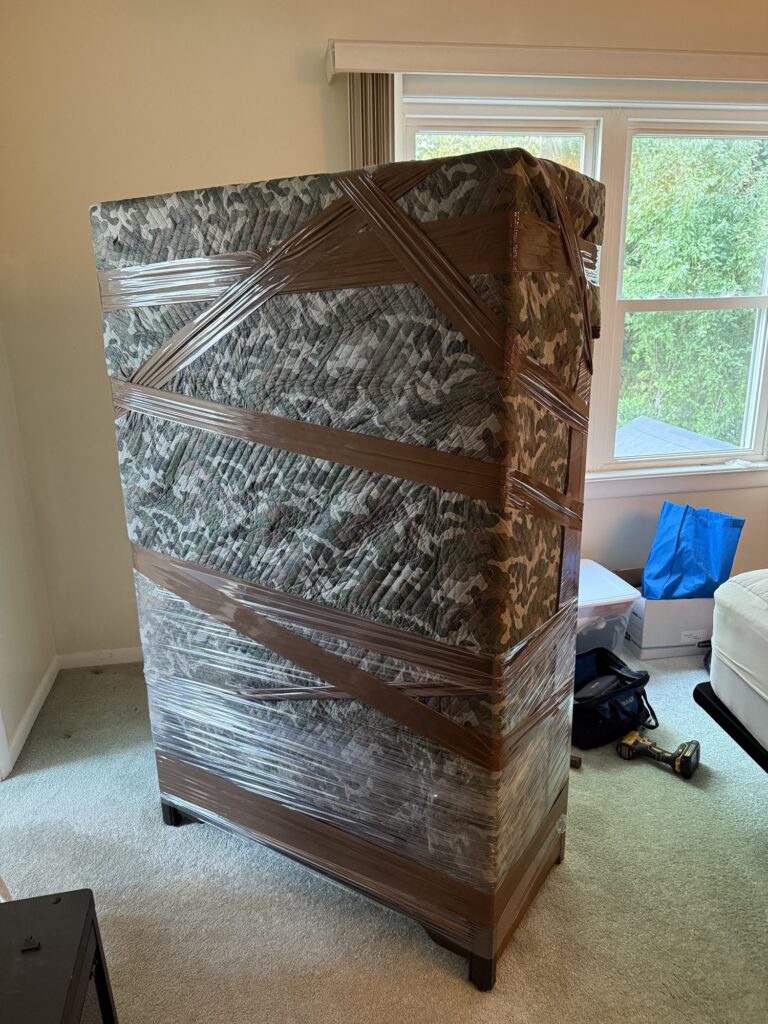
To move a bed, take the frame apart, wrap each piece, carry the mattress on its side and rebuild the bed where it will stand. The bed itself is rarely the hard part. The tightest turn on the stairway usually is, and that turn decides whether the frame comes apart and how the mattress gets out of the room.
We are CarePhilly Movers, and we work across Philadelphia and its Pennsylvania suburbs. Below is the order of the work, what wrapping does, how stairways change the plan, how long a move takes and where the truck parks.
Key takeaways: how to move a bed, in short
- Furniture disassembly comes first: the frame comes apart, and the headboard and rails go into moving blankets and stretch film. The mattress goes into a plastic cover and travels on its side. Furniture assembly happens in the new bedroom.
- The bill is the hourly rate for the time actually worked.
- Very approximate times: studio 3–4 h, one-bedroom 4–6 h, two-bedroom 6–8 h, house 8–12+ h.
- A Philadelphia Temporary No Parking permit costs $25 per 40 ft of curb per day.
- We work in Pennsylvania only.
To take apart a bed frame, work from the top down. Strip the bedding and take off the mattress. Lift out the slats or support pieces, then unbolt the rails from the headboard and footboard. Before you start, check the route. If the assembled frame clears every doorway and the tightest turn of the stairway, it can travel in one piece. Measure that turn as well as the front door, because the stairway is usually the narrowest point.
Getting a frame ready to wrap follows a set order. Photograph every joint before loosening anything, or mark the matching ends with a strip of tape, so you know which rail meets which post. Most beds come apart with an Allen key, a screwdriver or a small wrench. Turn the bolts by hand first, because a drill on a high setting is the usual way bolts get stripped.
Once the rails are free, nothing holds the headboard up. One person steadies it while the other removes the last bolts, and then the headboard leans against a wall on a blanket. Every bolt, washer and bracket goes into one bag, taped to a rail. Lost or mixed-up hardware is a common reason a bed cannot be rebuilt. For dressers, desks and other pieces, see how movers handle the rest of your furniture. Taking the frame apart before moving heavy furniture out of the room turns one rigid piece into flat parts that two people can lift and turn.
Wrapping the headboard and rails in moving blankets
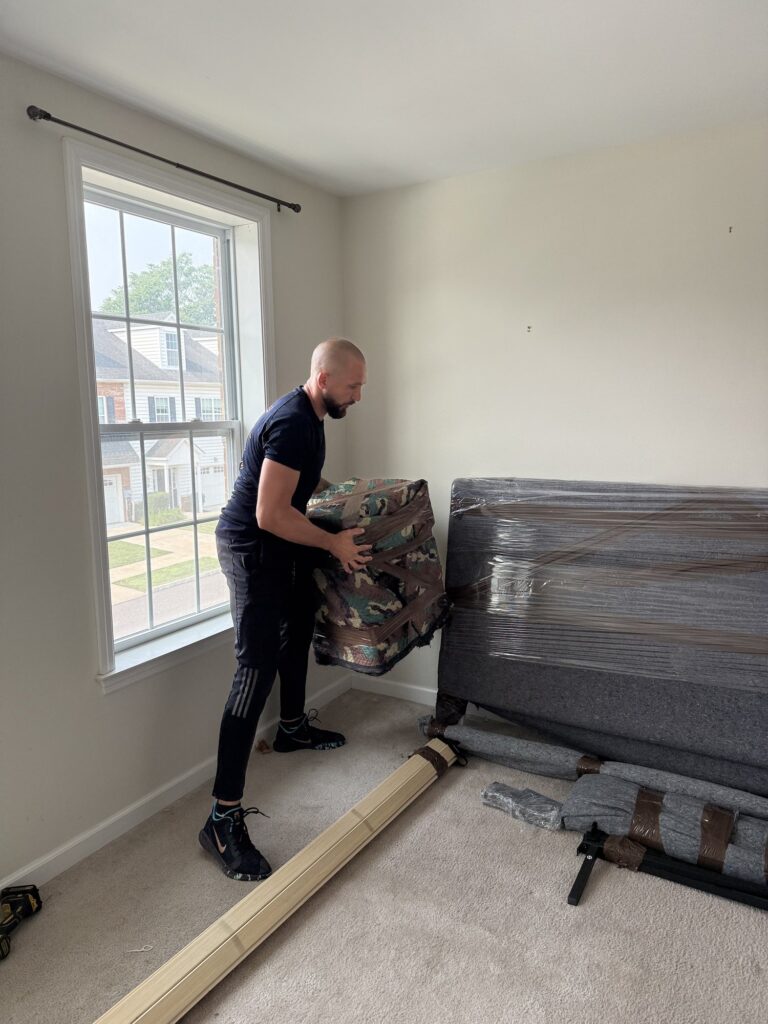
The headboard and the bed rails are best wrapped in moving blankets as separate pieces. That way each part has its own padding, and no two parts ride bare against each other. A headboard has wide flat faces and exposed corners. The rails are long and narrow, and they are easy to stack carelessly.
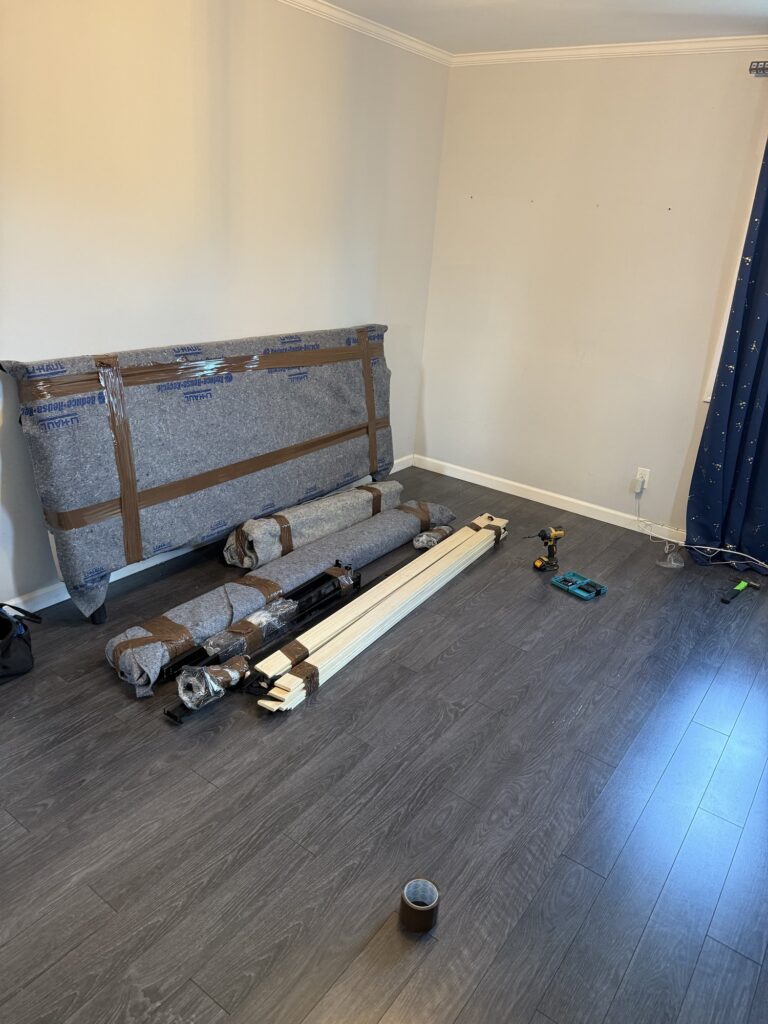
A headboard and its bed rails, wrapped for the move, wait on the bedroom floor for the carry. The faces and corners of the headboard need the most coverage, with the blanket folded over each corner rather than pulled across it. The rails are bundled with a layer of blanket between them, so they cannot rub against each other. The bag of hardware is best taped to the frame rather than packed in a box, so it travels with the parts it belongs to. If you would rather have the whole bedroom packed for you, see our packing services, along with the other packing supplies questions.
Stretch film over the blankets
Stretch film goes on over the moving blankets to hold them in place. It keeps each bundle closed during the carry and in the truck, so a blanket cannot slip off a corner halfway down the stairs.
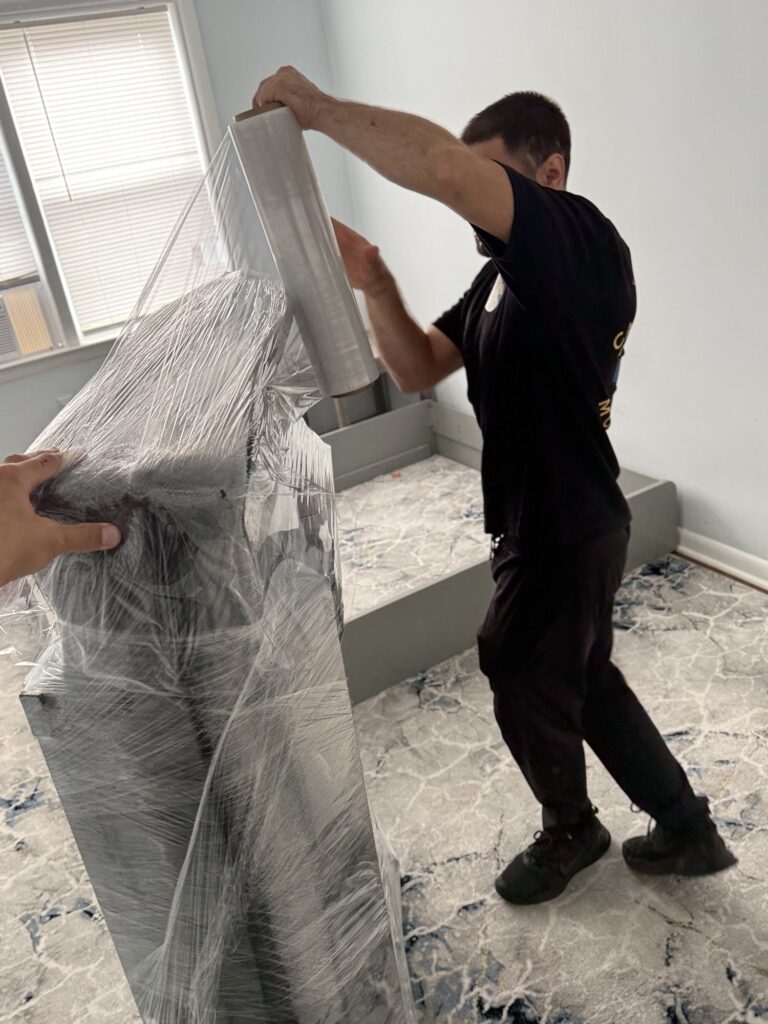
The film goes over the blankets, not directly onto a finished surface of the frame. The blanket touches the wood or metal, and the film touches only the blanket. The wrap should be tight enough that the bundle does not shift when you lift it, but not so tight that it crushes the padding flat. A few overlapping passes around the middle and the ends of each piece hold better than one long spiral. A finished bundle should be easy to grip by one end and easy for two people to carry.
How to move a mattress: plastic cover, carried on its side
To move a mattress, put it in a plastic cover and carry it on its side, not flat. The cover keeps it clean in the hallway and in the truck. Standing it on its side helps it keep its shape and gives two people even grip points along the top and bottom edges.
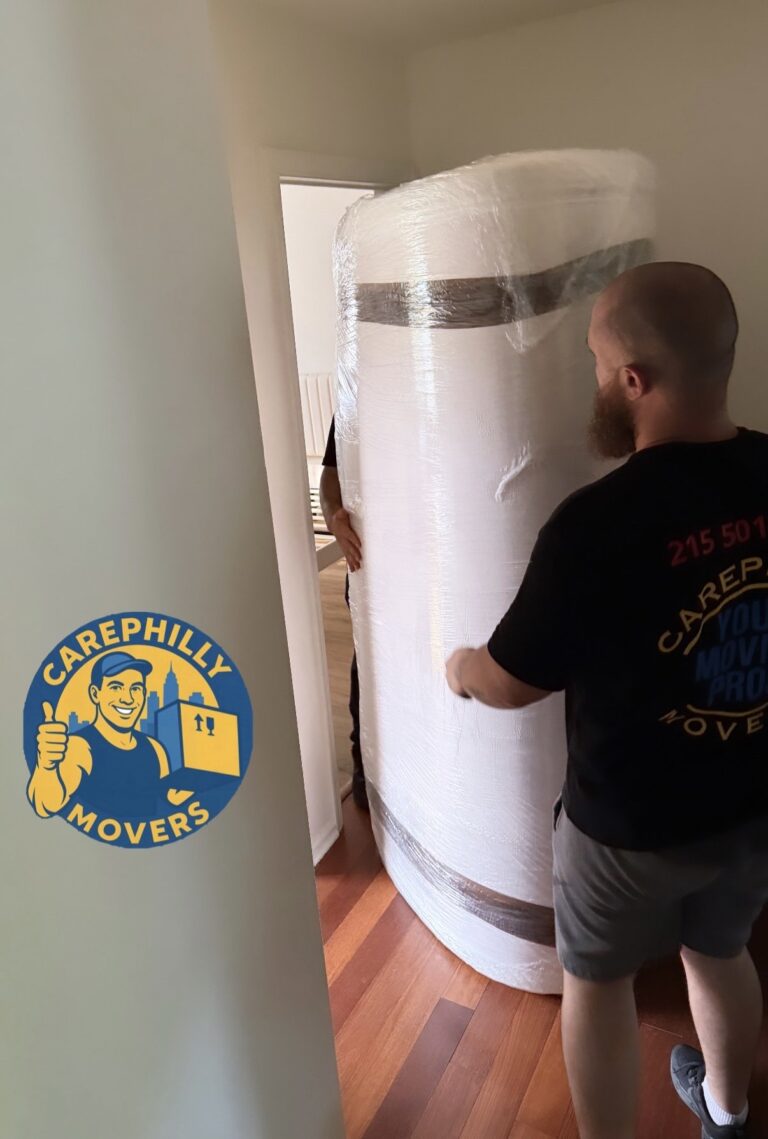
On its side, a mattress is only as wide as it is thick, so it clears doorframes that a flat mattress would catch on. In the truck it travels the same way: standing on its side and braced against the wall or other furniture, so it cannot sag or slide.
Most mattress problems come from two habits. Dragging a mattress flat along the floor wears the cover and puts all the strain on one end. Folding it in half to fit a tight turn bends the inside out of shape, and it may not lie flat afterward. The rule for moving heavy furniture applies here too: share the weight between two people and lift it instead of dragging it.
Stairs, rowhouses and trinity houses
Stairways are the hardest part of moving a bed in Philadelphia. Rowhouses are the most common type of home in the city. Trinity houses stack three or four floors of about one room each, joined by small winding stairways, and that makes moving furniture between floors hard.
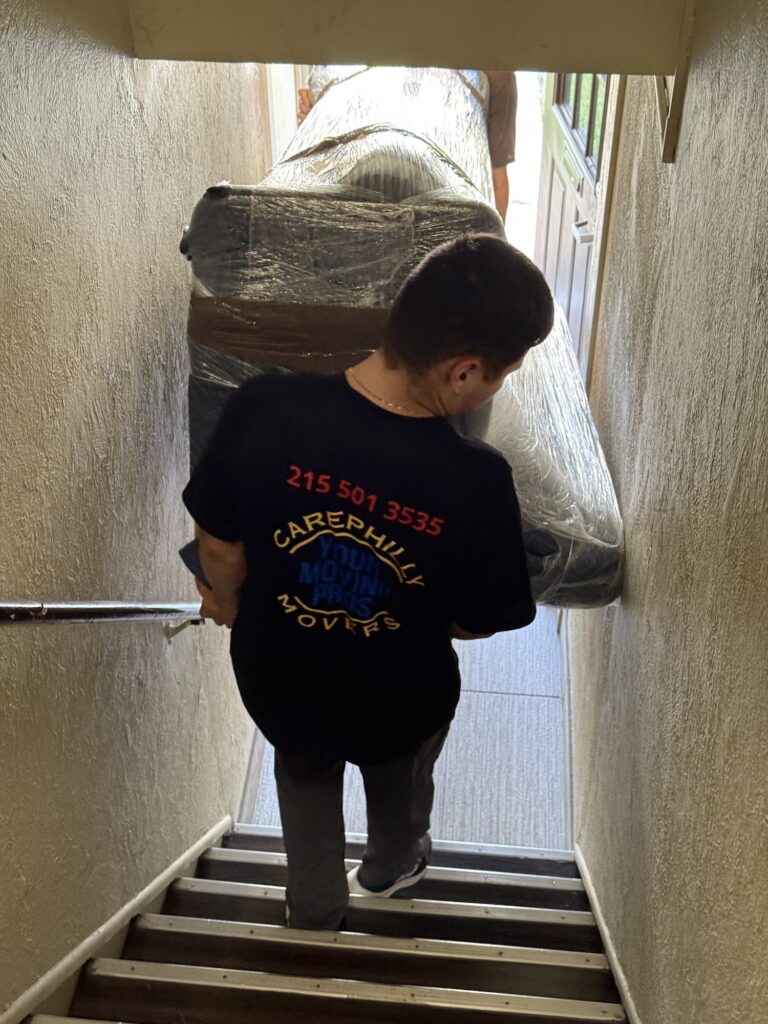
Rolling is not the same as folding a mattress in half. Some mattresses can take it and many cannot, and carrying a mattress on its side in a cover is the usual approach. A disassembled frame also helps on these stairs. A headboard and a few separate rails can each be turned and tilted around a winding landing. An assembled frame is a rigid rectangle that cannot be turned that way.
Some pieces will still not pass, whether in a house or an apartment building. The honest move is to say so before anyone forces the piece. One customer described a moment like that, with a couch rather than a bed:
“When they tried to take a couch down a flight of stairs that didn’t fit, they warned me about potential damage — it didn’t end up working so they moved it to a different location”
— Maya Hanson, Google
Putting the bed back together at the new home
We rebuild the bed at the new home. This is the second half of the same job, and assembly runs in the reverse order of taking the bed apart. Decide where the bed will stand before move day, because the frame should be rebuilt in its final spot. Moving it across the room after it is assembled is the hard way.
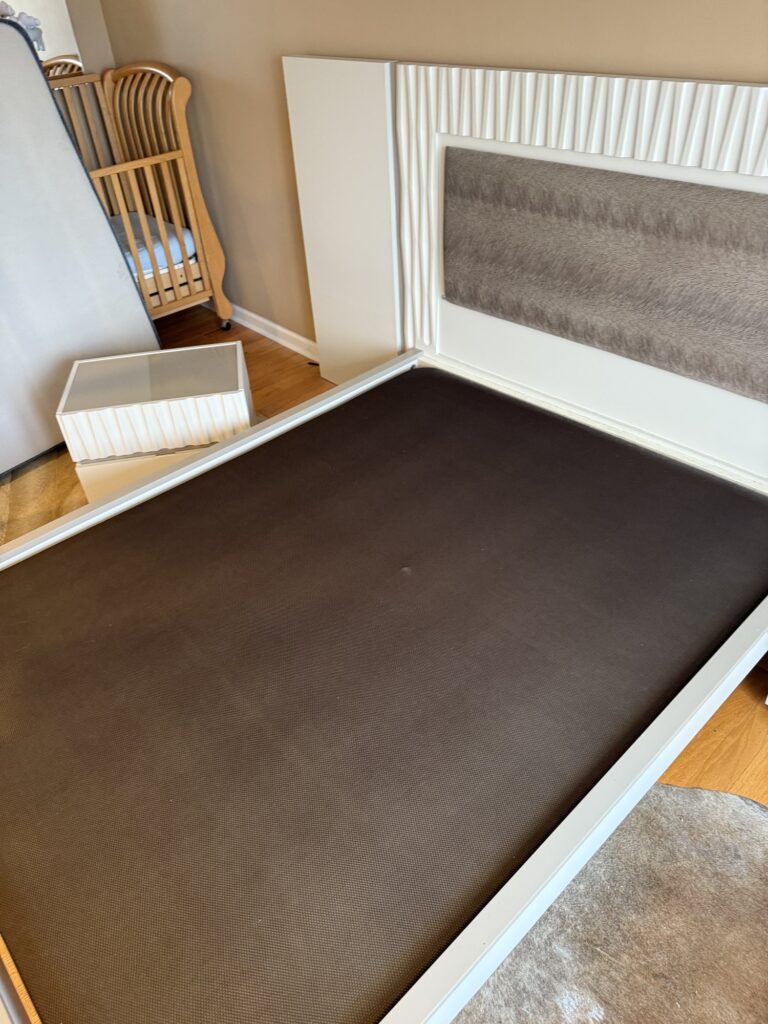
The finished result is a bed frame with its headboard assembled and standing in the bedroom. Getting there starts with unwrapping the parts in that room. Next, attach the rails to the headboard and footboard, using your photos or tape marks to match each joint. Then put the slats or supports back in. Before the mattress goes on, check that every bolt is tight and the frame is square. If the frame rocks or sits at an angle, re-seat that joint now, while the mattress is still off. For other furniture that needs building, there is our furniture assembly service.
IKEA beds and dressers
A flat-pack bed and a dresser are the two bedroom pieces that need a different approach from a standard bed frame. One is built to come apart, and the other usually is not.
How to disassemble IKEA furniture
IKEA furniture and other flat-pack pieces hold together with cam locks and dowels, which loosen a little with every rebuild. So the first question is whether a piece is worth taking apart at all. If a flat-pack bed or wardrobe fits through the route in one piece, moving it assembled is often the better choice. If it has to come apart, bag the cams and dowels by section, and keep the instructions if you still have them. Expect some joints to feel looser when they go back together.
How to disassemble a dresser
A dresser rarely needs to come apart beyond removing the drawers. The drawers come out first and are carried or wrapped separately, which takes most of the weight off the case. Only then is the empty case moved. Unscrewing the top or the back is seldom worth the effort.
Moving a mattress by yourself
Moving a mattress alone is realistic if it is the only piece and it goes into a covered car or van. Moving a frame plus a mattress up a winding stairway usually is not a one-person job. That calls for two people or a crew.
For a solo mattress move, you need three things:
- A plastic cover, so the mattress stays clean on the way out and in the vehicle.
- Straps, so it stays standing on its side on a dolly and in the van.
- A clear path from the bed to the vehicle, with doors propped open and rugs moved aside.
A dolly does most of the work. Stand the mattress on its side, strap it on and roll it. Do not drag it flat. For a mattress, a bed and a few boxes, our small moves service is built for that size of job. An old mattress you do not want to keep can go out with our furniture disposal service.
How long it takes and where the truck parks
A bed is part of a whole move, so the time depends on the size of the home. These ranges are very approximate.
| Home type | Approximate hours (very approximate) |
|---|---|
| Studio | 3–4 |
| One-bedroom | 4–6 |
| Two-bedroom | 6–8 |
| House | 8–12+ |
What moves the number up or down:
- how much stuff there is
- stairs and floors
- the elevator
- how far the truck can park
- furniture that has to come apart
- the distance between addresses
Travel time between addresses can grow on the Schuylkill Expressway (I-76). It is the busiest road in Pennsylvania, carrying about 163,000 vehicles a day in Philadelphia County, and it is known for chronic congestion.
For a truck parked on a city street, the city issues a Temporary No Parking permit. It costs $25 per 40 feet of curb per day, or $50 in Center City and University City. Request it at least four business days before the move. Forty feet is about two parking spaces.
For a single-family home, see our residential moving page. For a building, the apartment moving checklist covers the rest.
Is taking the bed apart extra?
We bill the hourly rate for the time actually worked: $150/hour for 2 movers with the truck, $200/hour for 3 movers and $250/hour for 4 movers, with a 3-hour minimum. There is no flat price for local moves, so furniture disassembly and furniture assembly are simply part of the time a move takes, like the carry and the drive. To see how hourly pricing works and what goes into the total, read how much movers cost.
Pennsylvania only
We move within Pennsylvania only. That covers Philadelphia and Northeast Philadelphia, plus Montgomery County suburbs such as King of Prussia, Plymouth Meeting, Willow Grove and Norristown. USDOT 4479673 is registered for moves within Pennsylvania only. For longer trips inside the state, see long distance moving within Pennsylvania. The full list is on our service areas page.
Send us photos of the bed
Send photos or a video of the bed, the stairway and the doorways. They show whether the frame needs to come apart, how the mattress gets out and how tight the turns are. The price depends on the size of the job, and we name the exact figure from your photos or video. Send them through the quote form. Before move day, it helps to strip the bedding and clear a path from the bedroom to the door.
FAQ
- What is the easiest way to move a bed?
Take the frame apart into the headboard, footboard, rails and slats, and keep all the hardware in one bag. Wrap the pieces in moving blankets and stretch film. Put the mattress in a plastic cover and carry it on its side. Then rebuild the bed in the new bedroom, in the spot where it will stand.
- How to move a mattress alone?
Put the mattress in a cover and stand it on its side on a dolly. Strap it down and clear the path to the vehicle first. One person can manage a mattress going into a van. A winding stairway is a job for two. Never drag a mattress flat across the floor.
- How to transport a mattress in a car or truck?
Put the mattress in a plastic cover, stand it on its side and brace it against the wall or other furniture so it cannot sag or slide. A covered vehicle such as a van or a moving truck is the better choice. A mattress strapped to a car roof is risky.
- Do I need to take apart my bed frame to move it?
Not always. If the frame fits through every doorway and the tightest turn of the stairway in one piece, it can stay assembled. Trinity houses stack three or four floors of about one room each, joined by small winding stairways. A rigid frame is hard to turn on stairs like that, so taking it apart is usually the practical choice.
- Is bed disassembly and reassembly included or extra?
We bill the hourly rate for the time actually worked, and that time includes taking the bed apart and putting it back together. How hourly pricing works is explained in how much movers cost.
- What if the headboard or mattress won’t fit up the stairs?
Not every piece fits every stairway, and forcing one through is the wrong answer. One customer, Maya Hanson, wrote on Google that when a couch didn’t fit down the stairs, “they warned me about potential damage — it didn’t end up working so they moved it to a different location”.
- Should I keep the bolts and slats together?
Yes. Put all the hardware in one bag and tape it to a rail or the headboard. Keep the slats bundled together too. Photograph the joints before you loosen anything. Lost or mixed-up bolts are a common reason a bed cannot be rebuilt at the new home.
- Do I need a parking permit for the truck in Philadelphia?
For a truck parked on a city street, the city issues a Temporary No Parking permit. Request it at least four business days before the move. The fee and the curb length it covers are explained in the section on timing and parking above.
- Can you move my bed to another state?
No. USDOT 4479673 is registered for moves within Pennsylvania only. We work in Philadelphia, Northeast Philadelphia and the suburbs of Montgomery County. We take on moves that start and end inside Pennsylvania, including longer trips within the state.