A certificate of insurance for movers is a short document from the moving company’s insurance side. It shows your apartment building, office landlord or HOA that the mover’s insurance exists before the crew uses shared lobbies, hallways and elevators. If your building asks for one, get its written requirements from management and send them to us early, ideally with your quote request. Then we check what the certificate can list before moving day.
A COI is not coverage for your belongings. It is proof for the building. Your items are covered by basic released-value protection, which we explain below. Most COI problems come from wrong names or late requests. The fix is simple: get the requirements in writing and send them early.
Key takeaways: what to know before moving day
- A COI shows that the mover’s policy exists. It is not the policy, and it does not cover your belongings.
- Apartment buildings, offices and HOAs often ask for one. Each building sets its own rules.
- The building decides whether it wants to be the certificate holder or an additional insured.
- Send us the building’s written requirements word for word, together with your move date and both addresses.
- A template you fill in yourself proves nothing to a building.
Certificate of insurance for movers: what it actually is
A certificate of insurance (COI) is a one- or two-page summary of a moving company’s insurance. It lets a third party, such as a building, office landlord or HOA, see that coverage exists without reading the policy itself.
Think of it as a receipt for moving insurance. It names the mover, lists the types of coverage on the policy and names the party it was issued to.
Keep three limits in mind:
- It is proof that a policy exists. It is not the policy.
- It does not add coverage for your sofa or your boxes.
- It is issued for a specific requester, so one building’s certificate is not reused for another.
Many buildings ask for a moving company certificate of insurance before they book an elevator or open a loading door. Preparing the certificate for your specific building is part of our COI assistance.
Why apartment buildings, offices and HOAs ask for a movers COI
Buildings with shared spaces are the ones that usually ask for a movers COI. That means apartment and condo buildings, office buildings and HOA communities, where a crew will use lobbies, elevators and hallways that other people share.
Building management or HOA requirements set the terms. Some buildings ask for a COI on every move. Others ask only when the elevator is reserved.
Office moving and other commercial moving jobs usually involve a property manager, so expect the question there. The same goes for areas like Plymouth Meeting, which grew with high-rise and garden apartment complexes and office buildings.
A house move often doesn’t need a COI at all, unless an HOA asks for one. Check with your HOA if you have one.
What happens without a certificate depends on each building’s own rules. Ask management ahead of time what it expects if the certificate isn’t on file by moving day.
What a building usually wants on the certificate
Most buildings hand you a requirement sheet. It usually lists the same few details:
- The exact legal name and mailing address of the building, its owner or its management company.
- The move date, and sometimes the unit number.
- Whether the building should be listed as certificate holder, as additional insured, or both.
- Sometimes specific wording that must appear on the certificate exactly as written.
Small details matter here. One missing word or a different abbreviation in a company name can mean the certificate doesn’t match what the building’s office has on file.
That’s why we ask for the sheet itself, not a summary from memory. A COI example from another building won’t help, because every building writes its own requirements.
Certificate holder vs additional insured
A certificate holder and an additional insured are two different roles on the certificate.
| Certificate holder | Additional insured | |
|---|---|---|
| Who it is | The party the certificate is issued to | A party named on the certificate |
| What it means | They receive the COI as proof that coverage exists | They get added status under the mover’s policy |
| How buildings ask | “List us as certificate holder” | “Name us as additional insured,” often with exact wording |
Your building decides which one it needs. Send us its written requirements word for word, and we’ll confirm what can be listed once we’ve seen them.
Our insurance and licenses, in exact terms
Our cargo insurance filing (Form H) and liability insurance filing (Form E) are on record with the PA PUC.
Your belongings are covered separately: every move includes basic released-value protection of $0.60 per pound per article. That basic level is not full replacement value.
Cash, jewelry, documents and medications travel with you, not on our truck.
CarePhilly Movers is licensed by the Pennsylvania PUC as a household goods carrier, utility code 8928034. USDOT 4479673 is registered for moves within Pennsylvania only.
You don’t have to take our word for any of this. Check our entry on the PA PUC utility page and in the SAFER company snapshot registry (search 4479673). These facts describe our company only.
How to request a COI from us before moving day
The way to get a moving COI in Philadelphia and its suburbs is to get your building’s requirements in writing and send them to us early. The best time is together with your quote request.
The earlier we see the exact wording, the fewer surprises you’ll have on the day. Phone notes like “they said something about insurance” usually turn into a second round of emails.
Here’s what to send us:
- The building’s or HOA’s written COI requirements, as a photo, PDF or forwarded email.
- The legal name and address of the certificate holder.
- Any additional insured wording, copied exactly.
- Your move date.
- Both addresses, origin and destination. Each building may want its own certificate.
If you’re moving into a building that also has rules, ask both managers. A certificate of insurance for moving out of one building doesn’t cover moving into another.
For last-minute moves, call the building first and ask exactly what it needs. Then call us. We pick up the phone from 7 a.m.
Moving day at a building that asked for a COI
On moving day, the COI pays off quietly.
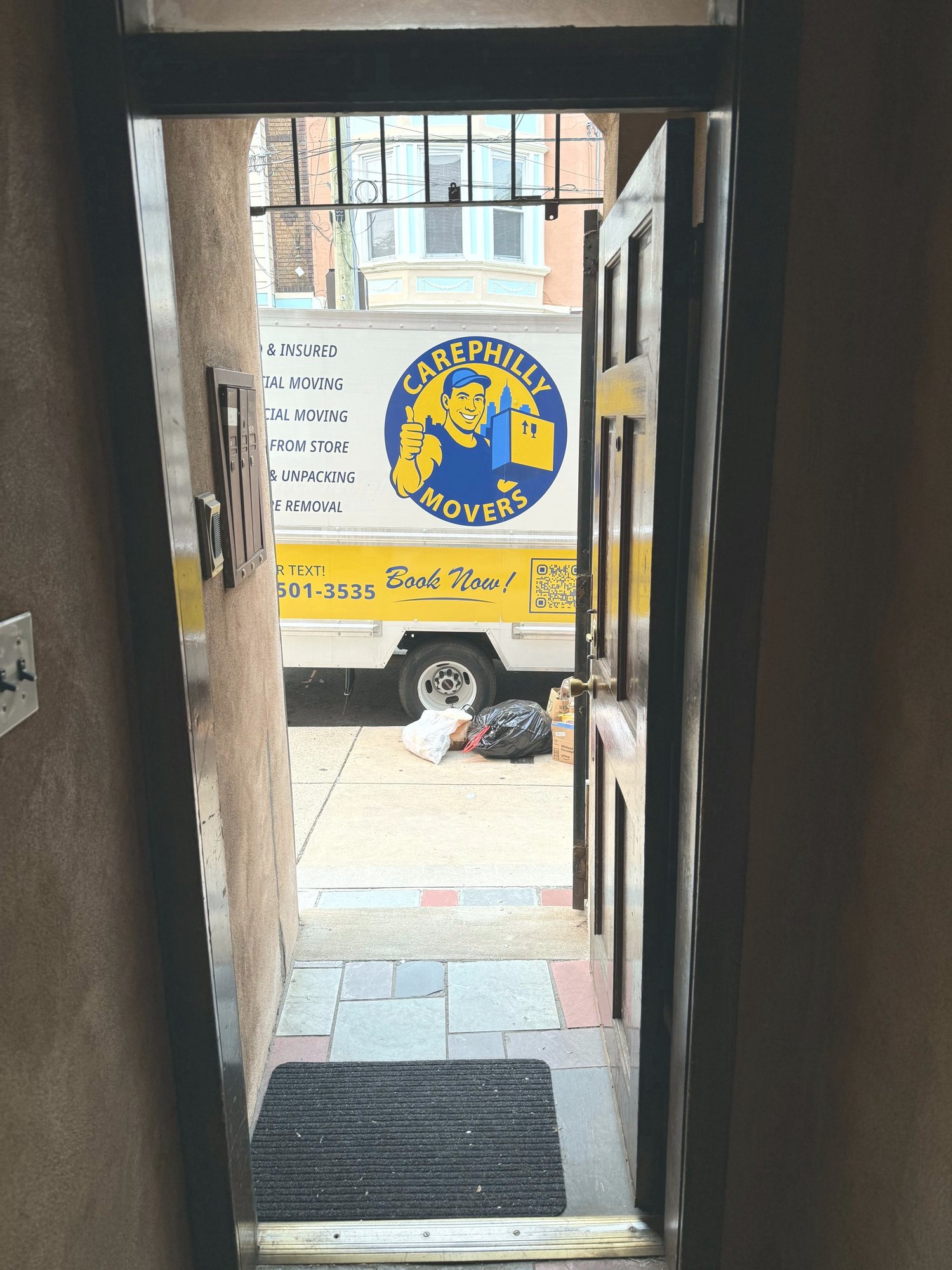
Here is our truck outside a building entrance. When the COI is on file before moving day, the crew doesn’t wait at the door for paperwork.
From there, a few things decide how long a residential moving job at an apartment building takes: the elevator and whether it’s reserved, how far the truck can park, and stairs and floors.
Ask management about elevator booking when you ask about the COI. More on moving around the city is on our Philadelphia page.
Templates, samples and fake certificates
A blank COI template or a free PDF you fill in yourself proves nothing to a building. The certificate has to come from the mover’s insurance side and be made out to the specific building.
People often look for a sample COI to save time. The faster route is still to send the building’s requirements to the mover.
A fake or altered certificate gives the building no real coverage. It’s just paper. Buildings may also check a certificate with whoever issued it, and that’s when an edited document falls apart.
If you want to verify a mover before handing over your building’s details, use public registries. Our Pennsylvania PUC household goods carrier license can be checked through the PA PUC and SAFER links in the insurance section above.
Send your building’s requirements with your quote request
The quickest way to sort out a movers COI is to send it with your quote. Use the quote form to send photos or a video of what’s moving, plus your building’s COI requirements. The estimate is based on photos, a video or an in-person look. It is non-binding: the bill is the hourly rate for the time actually worked.
We cover residential and commercial moving across Philadelphia, Northeast Philadelphia and Montgomery County suburbs such as King of Prussia, Plymouth Meeting and Willow Grove. We don’t take moves outside Pennsylvania. Loss or damage claims go in writing within 5 calendar days after the move.
FAQ
-
What is a certificate of insurance for a moving company?
It’s a short document that summarizes a mover’s insurance. A building, office or HOA uses it to see that coverage exists before a crew uses its lobby and elevators. It is proof of a policy, not coverage for your belongings. Our cargo (Form H) and liability (Form E) filings are on record with the PA PUC.
-
How do I get a certificate of insurance?
Ask your building or HOA for its COI requirements in writing. Then send them to us early, along with your move date and both addresses. The easiest way is through our quote form. The earlier we see the exact wording, the smoother the setup goes before moving day.
-
Who provides a COI when moving?
The moving company provides it, made out to the building or management company that asked for it. Your part is to pass along the building’s requirements. You don’t fill in a template yourself. Preparing the certificate for your building is part of our COI assistance, so send the requirement sheet as it is.
-
What happens if you move without a COI?
If your building requires a COI, it may not let the crew start until it has one, and the move can stall. Rules differ from building to building. Some ask on every move, others only when the elevator is reserved. Check with management ahead of time so moving day isn’t spent waiting.
-
Is a certificate holder the same as an additional insured?
No. The certificate holder is the party the certificate is issued to. An additional insured is a party named on it for added status under the mover’s policy. Your building decides which one it needs. Send us its exact wording, and we’ll confirm what can be listed once we’ve seen it.
-
Does the COI mean my belongings are covered at full value?
No. The COI is for the building. Your items are covered by basic released-value protection of $0.60 per pound per article, which is not full replacement value. Keep cash, jewelry, documents and medications with you rather than on the truck.
-
Can I use a free COI template or sample PDF for my move?
No. A template you fill in yourself proves nothing to a building, because the certificate must come from the mover’s insurance side for your specific building. You can verify our Pennsylvania PUC household goods carrier license on the PA PUC page (utility code 8928034) and in the SAFER registry.